
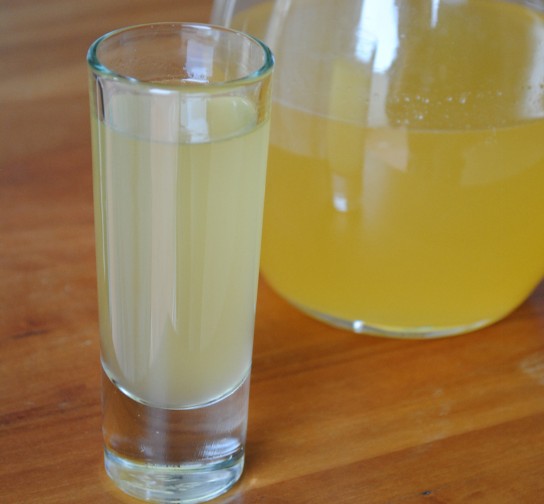
This post comes to us courtesy of food writer and editor James Schend, blogger at Dairy Freed.
First created on the island of Capri, this smooth, refreshing and deceptively strong liqueur was quickly adopted by Sicily and other citrus-growing regions of Italy a little over a century ago. Limoncello is often served chilled as an after-dinner digestivo, but is quickly becoming popular with bartenders and mixologists around the world as an ingredient in cocktails.
I’ll admit, there are many recipes for limoncello that are faster to make, and trust me, I’ve tried a lot of them. What I’ve learned from a lot of testing is that time and patience will give you an extremely refined and smooth liqueur. In fact, I have had a couple of bottles tucked away for over a year now that just seem to get better and better.
Since limoncello is made solely from the skin of the lemons, the end result is surprisingly sweet with a strong lemon flavor. Traditionally made with lemons, you’ll find almost any citrus fruit will work. My personal favorite is pink grapefruit, but oranges, tangerines and especially blood oranges make exceptional variations. When I tried a lime version I found it a little too bitter on its own but fantastic when added to cocktails, like mojitos or vodka tonics.
151 proof alcohol is sometimes difficult to find, but ask your local liquor store owner. The two stores in my neighborhood carry it but don’t have it out on the shelves. The first time I asked for it I was questioned why I wanted something so strong. In order to buy it I ended up promising a sample when it was done. Three months later I got the seal of approval from the shop owner.
Limoncello
18 large organic lemons
1 (750 ml) bottle 151 proof alcohol, such as Everclear
1 (750 ml) bottle 80 proof vodka
4 cups sugar
3 cups water
Wash and dry the lemons. Using a vegetable peeler, remove the yellow skin, taking care to not include any white pith, as this will make it bitter. Place lemon skins in a glass gallon-size jar and add the 151 proof alcohol and vodka. Cover tightly and place in a cool, dark place. Gently stir every 7 days. After 5 weeks remove one of the peels and bend it; if it snaps in two then proceed with the recipe. If it still bends without breaking, continue aging for a week or more until the peel does snap in two.
In a large saucepan, combine sugar and water and cook over medium-high heat just until the sugar dissolves. Do not allow mixture to boil. Remove from heat and allow to cool to room temperature.
Gently remove the peels from the alcohol with a slotted spoon or a pair of tongs, trying to keep pieces intact; discard peels. Pour mixture through three layers of cheesecloth into a clean bowl. Then strain mixture through coffee filters. This will take a fair amount of time to strain the entire mixture and you’ll need a number of filters.
After straining, combine the alcohol and sugar solution and stir to combine. Cover and place mixture in a cool, dark location for at least 6 weeks.
Filter mixture once more through fine-textured coffee filters before pouring into smaller bottles. Seal completely and continue to store in a cool, dark place until ready to serve.
About the author: A graduate of The Culinary Institute of America, James Schend’s culinary career began when he won his first cooking contest at 8 years old. He’s gone on to write and develop recipes for national magazines and culinary websites. His own blog Dairy Freed focuses on the challenges of dairy-free cooking.
150 comments
Getting ready to make limoncello and I was looking for the right recipe…sounds like a great winner! Only problem is I have to be patient during the next five weeks! Picking my Meyer lemons 🍋 in a sec. the owner of the house used to make this before I bought it…now even more memories and cocktail hours! It gets hot here so placing in the refrigerator is okay for cool dark place right?
It’s a pity you don’t have a donate button! I’d certainly donate to this brilliant blog! I guess for now i’ll settle for bookmarking and adding your RSS feed to my Google account. I look forward to brand new updates and will share this blog with my Facebook group. Talk soon!
Great site. A lot of useful information here. I’m sending it to a few pals ans also sharing in delicious. And of course, thanks on your effort!
Just bottled my second batch of this!
First Batch was ruined by organic sugar. Was delish…but brown. This time I used regular Sugar and oh my….
Had to substitute 151 everclear and bottle of vodka with 191 everclear (only I could find) and a laaaarge bottle of vodka (sorry, can’t recall the size- looks like family size lol- 40oz?) Then when it was time to add syrup, used more water in the syrup, until my 1 gallon jar (Target) was full.
Also this time I used washed clean organic (regular) lemons, about 20 of them, and after full cycle of waiting for the time to bottle, in the end didn’t even need to filter again.
I’ve brought limoncello from Italy before- this recipe gives exactly the same taste/experience.
I’ll be trying to sub lemons with grapefruit and see how it turns out.
Hello,
I am wanting to make the limoncello, but would like to give it that pink color to distribute as favors. Is there a way to get the pink color as opposed to the yellow one?
Thanks.
I aⅼways used to study paragraph in news papers bƄսt now as I am a user of іnnternet thus
from noow I am using net for articles or reviews,
thanks to web.
What’s is the juice(alcohol) yield I should expect from this recipe?
Can I just add ounces or will it become a little greater from extracting what ever juice out
of the lemon skins
[…] and flavor from grain alcohol that’s been steeped in lemon zest with simple syrup. While limoncello is fantastic served chilled, it’s also wonderful in cocktails, like limoncello […]
Существует такая услуга – добровольное медицинское обслуживание (или ДМО).
Она предполагает, что вы вносите небольшую сумму за то, что посещает врачей целый год бесплатно.
Однако соцопросы показывают, что лишь 6% жителей Питера знают о ее существовании.
По какой причине?
Потому что частным клиникам выгоднее брать плату за каждый визит.
А если какой-нибудь сотрудник клиники посоветует добровольное медицинское обслуживание клиенту – это сулит ему увольнением.
Информация о ДМО уже спровоцировала много скандалов, после того как информацию об этом распространил один врач.
Его уволили , после того, как он посоветовал ДМО своему пациенту.
Самое удивительное, что официальные положения по ДМО присутствуют в открытом доступе, просто находили на эту информацию только случайные люди.
Как отстоять свои права?
О правилах предоставления такой услуги и обязанностях клиник можно узнать, сделав запрос в Яндексе: “добровольное медицинское обслуживание”.
Обязательно обслуживание, а не страхование.
34j5c6h86
I used 2 x 750ml Everclear 151 and zest of 35 meyer lemons.
I’m adding additional water to my sugar syrup to get the % alcohol down to 30 rather than using vodka which I’m worried will give a different taste.
After adding the sugar, I tasted it and it had a very grain alcohol smell and flavor. Does this mellow out during the next 6 week resting period?
I think you have two issues happening here which will lead to the alcohol smell and flavor. First, while I love Meyer lemons, they are much more mild than the standard lemons you’ll find in most stores. I think they can make a very nice limoncello and if it were me, I probably would have started out using a lower proof alcohol, like the vodka, instead of using the 151 Everclear. Second, having used all Everclear, getting the final proof down to around 30 is going to take a lot more water which will dilute the flavor of the lemons and leave only the flavor of the alcohol. If you have more Meyer lemons I would add as much zest as you can to the solution now and see if we can extract any additional flavor. If Meyers aren’t an option now, you could always add regular lemons.
Should I use 8 ounces of sugar asa measure of 1 cup? Or volume?
Yes, 1 cup of sugar actually weighs 8 ounces so either way will get you the correct amount.
Thank you so much!!!
From what I read it weighs 7.1 ounces?
Hello! I’ve followed your recipe exactly so far, and it has been steeping for 7 weeks. I checked the lemon rinds today, and they do not snap when bent. Should I let them continue to steep before proceeding? Also, is the filtering that you describe important even if my lemon peels are big pieces that are easily removed thru a colander? is the fine filter of a coffee filter necessary?
Best!
Joey
I usually keep going until they start to snap unless I’m in a rush and need it quicker. If after 8 weeks and they still aren’t snapping then I would remove them and continue with the recipe. By that point you’ll have gotten all of the flavor out of the peels.
Filtering isn’t necessary at all, it’s only for visual effect. If it’s not cloudy at all after removing the peels then you could skip the filtering step.
[…] hue and flavor from grain alcohol that’s been steeped in lemon zest with simple syrup. While limoncello is fantastic served chilled, it’s also wonderful in cocktails, like limoncello […]
[…] sweet, dull limoncello. I stumbled across a recipe, via the Williams-Sonoma blog, Taste. I followed James Schend’s recipe pretty closely, but I actually forgot about my limoncello down in the basement after week five, […]
I’ve made both the Limoncello and Pompelmocello, bottled them and gave them away as Christmas gifts. I’m down to my last bottle of each (which I squirreled away in my freezer). They even survived a cross country move! I’m now inspired to try something new. Has anyone ever tried making rose liqueur?
Thank you, James, as always for starting me on this journey! 🙂
Some things are optional, some are not… making Limincello with Vodka is NOT making Limoncello! Everclear is ESSENTIAL! 190 Proof; NOT 151 Proof! If you want it to taste like it does in Italy, first use organic lemons. Also, when you get to the Simple-Syrup step, fast-simmer or slow-boil the PURE FILTERED OR BOTTLED WATER and sugar for fifteen minutes after the mixture becomes clear (sugar disolved.) Let it cool completely before bringing it anywhere near your Everclear/lemon peel mixture. The longer the peels are steeped in the alcohol, the purer the flavor. Eight days minimum, when the peels are white, longer steeping accomplishes nothing. Then remove them with a plastic slotted spoon, keep metal away from the mixture, especially Aluminum; as it interacts with the acids in the lemon oils. 1 Liter of 190 Proof Everclear to the peels of 15 Lemons, with 1Liter of water with 5 1/2 cups of cane sugar yields a 90 Proof Limoncello. To get 100+ Proof Limoncello, add another 1/2 to .75 Liter EverClear. the higher the Proof, the longer you will want to age it before freezer-storing. The aging is best accomplished AFTER combining the simple syrup and lemon/Everclear solution. If you have no patience; 8 days is adequate to steep the peels, but once you taste it having been aged 45 days after combining, you’ll turn your nose up at the “short-cut” versions!
Alfred,
How did you get these calculations?
Your sugar and water for the simple syrup seem to be drastically different than most recipes.
Also, how did you calculate the final ABV?
Alfred, I agree with Adam, something with your math seems off….
This recipe sounds wonderful. Can’t wait to try it. I went to Elba and Positano where Limoncello is made and was able to bring some back home. They also had cream version. Do you have ideas on how to make it with cream?
I have bottled the lemoncello and wondered if I can make it somewhat more sweet after bottling? It is a bit strong! I goofed somewhere along the line but don’t want to waste all that I have bottled. Thank you.
Hi Susan,
Yes, you can add more of the sugar syrup according to your taste. I’d start out slowly and add a little bit at a time.
James
I just finished my first batch of limoncello and a batch of grapefruit. The both taste amazing and I will definitely be making some more as it is disappearing very quickly. I do have a question though, mine came out clear with just a tint of yellow instead of “milky” like in the picture. Did I do something wrong?
Hi Alana,
I’m glad you liked them. Grapefruit is my all-time favorite.
Not turning “milky” will happen from time to time. When you add the simple syrup to the alcohol mixture and it turns cloudy, this is called the louche (or Ouzo) effect. http://en.wikipedia.org/wiki/Ouzo_effect
It has to do with the amount of essential oils that came out of the citrus zest. If you didn’t get enough then the mixture will remain clear.
There are a number of reasons why you wouldn’t get enough extracted oils, starting with the fruit themselves. They may not have had a lot to begin with so you couldn’t extract a lot. Or it could be the amount of time they sat in the alcohol wasn’t long enough.
Did you use 151 proof and 80 proof vodka? Sometimes if a lower proof is used you won’t get the correct extraction.
In any case, I’ve made a number of batches that didn’t turn cloudy but they still tasted great so I wouldn’t worry about it right now. If you’d like to try another batch, you could go up on the amount of zest, which should do the trick.
James
Hi James
I stumbled upon this site a couple of months ago and was interested in trying to make your recipe. Like many before, in my area i could only find the 190 proof. I made one batch using the 190 proof and a month later took a ride to the next state over and bought a bottle of the 151 proof that you recommended. The first batch came out way to strong.
I just bottled the second batch and am very happy with the outcome. The only issue i have is that the second batch seems to be alittle light on the lemon flavor. So, i’m guessing the next batch i make will include more lemons in the initial stage.
Any other suggestions on how to increase the overall lemon flavor on any future batches?
Maybe a certain type of lemon? Or more lemons?
Hi Matt,
I have seen a number of people that could only purchase 190 proof so I’m working on a batch using that to see what I can do to help tame it a little bit.
As for the increased lemon flavor, more lemon peels will certainly help with that. I would stay away from Meyer lemons as they are more subtle in flavor than regular commercial lemons. I also scrub my lemons before using them to make sure there is no wax or anything on the lemon that could inhibit the transfer of oils to the alcohol.
Good luck and stay tuned for the results of my 190 test. I just started it last week so it’s going to take a little while.
James
I just made my first batch and I’m a bit disappointed that it’s not more lemony. I may have had too much vodka for the amount of lemons used. Is there anything I can do to increase the lemony flavor? I already added the simple syrup.
Hi Karen,
What you can try is adding more lemon peels and letting it sit. I’m not sure though how the sugar will react with them. Another option would be to pack a bunch of lemon peels into a small amount of vodka, let it sit for 6 weeks and then add that. It will make the final drink a little stronger but it should also be a little more lemony.
James
Can I use 190 proof Everclear? If not, can I dilute 190 proof Everclear with water so that it is more like 151 proof? Wd so much appreciate your thoughts?
Hi Sarah,
I would recommend adding water to the 190 proof Everclear to cut it’s strength. If you look at the comments right above yours you’ll see someone who did use 190 proof and found it way too strong. I would suggest using 2 cups of 190 proof and 1 cup of water to replace the 750ml bottle of 151 Everclear.
Good luck!
James
The grapefruit with the sparkling water sounds like a fantastic summertime drink Lynn. Honestly, grapefruit is my all-time favorite.
Good luck with the next batch!
I just added the simple syrup to my pompelmocello. When I started the vodka and Everclear mixture I used 190 proof Everclear because that was all I could find at my local Total Wine store. Just a sampling of the completed mixture seemed really strong. Would you recommend adding another full batch of simple syrup? Or is there something else I can do to “tone down” the alcohol?
Hi Lynn,
Yes, I think you would have a batch that would hover around 80 proof instead of around 55 – 58 proof. That’s just a little strong, at least for me.
I wouldn’t add another batch of simple syrup as that would make it very sweet. One option would be to add just some water. That would cut the alcohol level but not add any more sweetness. The only thing with that is you’ll also dilute the lemon flavor. To counter that, I’d probably add another cup of water and then add some more lemon peels for a few weeks.
Good luck and I hope you like the flavor of it!
James
Hi again James, I am now going to make a batch of orange with vanilla. I wondered how many vanilla beans you would recommend adding?
Hi Lynn,
How did you make out with the first batch?
When I’ve made the Orange-Vanilla I added two split vanilla beans after I strained out the peels. So add the simple syrup and then pop in the vanilla beans. After 6 weeks, I gave the container a good shake to make sure I got all the vanilla bean seeds out before I removed them. I also didn’t strain it the final time since I wanted to keep the vanilla bean flecks. it’s a little cloudier than normal but everyone loves to see the black flecks. They will sink to the bottom of the bottle so be sure to shake it up before pouring.
James
James, I just finished bottling my first batch of pompelmocello with 190 proof Everclear and vodka. I have to tell you that I didn’t following your advice because I’d already thrown the grapefruit rind out and I didn’t have any more grapefruit. (I didn’t use store-bought grapefruit, I used grapefruit from a friends tree). I was really afraid that adding water would dilute the grapefruit flavor, so I left it. BOY, is it strong! It is really too strong to sip on its own. But, the good news is that it tastes really good mixed with club soda. So, all is not lost! 🙂 My second batch is limoncello. I used the 190 proof Everclear and vodka in that one too. I hadn’t yet removed the rinds, so I added two cups of water to the mixture of alcohol and rinds and I’m letting it sit for a couple more weeks before I add the simple syrup. I’ll let you know how it turns out. I do know that I won’t be using the 190 proof Everclear again!! Thanks for all your advice! I really appreciate that you respond to my questions!
Hi James,
I just finished bottling my first batch of pompelmocello last weekend. I did not follow your advice about adding water to it because I’d already taken the rinds out of the alcohol mixture and I didn’t have any more of the grapefruit I used initially. I got my grapefruit from a friend and I didn’t want to use store bought grapefruit. So I just added the simple syrup and hoped for the best. WHEW! It is really strong! But, all is not lost. If we mix it with club soda, it’s fabulous! I have a batch of limoncello that I started a few weeks after the pompelmocello and I used the same combination of alcohol: 750 ml of vodka and 750 ml of 190 proof Everclear. The limoncello was ready for simple syrup this past weekend. Since my experience with this combination was not so good, I added 2 cups of water to the lemon rinds and the alcohol and put it back to sit for a couple more weeks. I’ve learned from my mistakes… I won’t be using the higher proof Everclear again! I’ll be sure to let you know how the finished limoncello turns out. Thanks for your replies!
Hi James
I should have stated that I need to add 2.3l of my 75° vodka to approximately match your 750mls of 151° + 750mls of 80° + 750mls water.
Gordon
Hi Gordon,
I would try backing off on the water as much as possible. You can dissolve about 400 grams of sugar in 200 ml of water. Any more than that and the sugar won’t fully dissolve. However, you could use superfine (or quick dissolving) sugar and just pour whatever doesn’t dissolve into the alcohol mixture. After 6 weeks of additional resting it should dissolve.
Another option that came to mind that might be worth a try, if you’re game, is to replace some of the water with vodka. The danger here is it could ignite when heating so you’ll need to be very careful and keep an eye on it. I would do a 50-50 mix of water and vodka and then heat it very gently until the sugar dissolves. You don’t want to bring it to a boil, just enough to get it warm to help the sugar melt. Alcohol starts to burn off at around 75 degrees C (165 F) so you’ll want to keep it under that.
The last option would be to add the superfine sugar directly to the alcohol mixture after it’s strained. I’m not sure how that would work but in theory it could work.
Good luck and I’d love to hear what you ended up doing,
James
Hi James
Very interesting discussion.
I will keep in mind your recommendations for using Meyer lemons with your recipe.
I cannot find alcohol stronger than 75° Vodka here in NZ. Obviously if I used this straight in your recipe it would be a lot weaker. If I reduced the amount of added water to make the syrup I would increase the alcohol content.
Theoretically I would need to remove 800mls of water from the recipe to match yours. As there is only 750mls of added water this obviously won’t work. What about either:
(1) Make the syrup as strong as possible – sugar :water 2:1 or stronger. I don’t know how strong you can go with the sugar and still have a solution.
(2) Dissolve the sugar in some of the alcohol lemon zest mix or keep some of the alcohol back when first adding the zest and hence eliminate the need to add any water.
What do you think?
Gordon
Hi James,
Just reading this now. Planning on making this recipe with Meyer Lemons. Should I change the (simple syrup) sugar water ratio from this recipe, since Meyer’s tend to be sweeter than say Eureka lemons? I don’t care for limoncello to be too sweet. Recommendations greatly appreciated.
Hi Monica,
I’ve tried it with Meyer lemons and you’re right, they are sweeter than regular lemons. I also found the flavor to be a bit lacking when I did it. What I would recommend is using more Meyer lemons, if you have them. If you have enough, I would increase by at least half if not more.
When you’re getting ready to add the simple syrup, I’d suggest cutting the sugar by a cup or cup and a half but still keep the same amount of water. You can always add more sugar if it’s not sweet enough.
Good luck and let me know how it turns out for you!
James
[…] Long story short, many of you who know me, know that I love to entertain friends on my patio late into the evening. I began considering what to offer for after dinner drinks and remembered that the Italians have a long history making and serving Limoncello. Meanwhile, my husband and I were on a trip to Napa and enjoyed a dinner at the Coppola Winery. I noticed they offered Limoncello on their menu, but sadly was informed that Coppola’s nephew, who normally made the concoction was not in the city and they were currently out. This only piqued my curiosity even further! Not to be daunted, I purchased some pre-made Limoncello from my local liquor store and even though it was lovely, in the back of my mind I remembered that Francis Ford Coppola’s nephew made his and just knew I had to give it a try. The hunt began: to find a GOOD recipe. That’s half the battle isn’t it? To go to all that trouble and end up with something that’s well…just okay?? The horror! I scoured the internet and read review after review of posters who actually USED the recipe and had successful results. I landed with this recipe from Williams Sonoma. […]
The pompelmocello was wonderful! Very subtle, but distinct difference. Great suggestion. Now I am hooked! I was just reading a book where they mention black currant vodka. Any idea on how to make this?
That’s great to hear Kimberly! Grapefruit is my favorite. I need to start another batch, thanks for the reminder.
I haven’t made black currant vodka before but I did see this recipe which looks really good.
http://www.withaglass.com/?p=5811
Good luck and I’m glad you liked it!
James
I just bottled my first batch today; I started it back on July 25th so have been very excited to see how it tastes. Unfortunately, although drinkable, it seems to lack some depth of lemon flavor. What suggestions do you have for my next batch? I followed the above instructions and used organic lemons. I appreciate any thoughts you have to enhance the lemon flavor next time.
Hi Kelli,
Sorry to hear you weren’t thrilled with the results. A lot depends on the lemons and the size. Sometimes they are smaller or older and will be less potent. Next time you could try using more of them to get a real big punch of flavor.
James
Hi James. We love this! Thank you for the great recipe, which we followed to the letter. We’ll do it again soon. Just an idle question — what is the proof of this limoncello? Almost too tasty!
I’m glad you like it. I’ve been making this for years and have loved every batch. I’m not 100% sure what the final proof would be but doing some rough calculations, it should be somewhere around 60 proof. Enjoy!
James,
I am Italian and I am excited to be trying your recipe. I do have a quick question…I mistakingly bought 190 proof everclear and 100 proof vodka. I am worried that this will be too strong in the end. Could I cut the alcohol content when adding the sugar/water mixture just by adding more water to the ratio and keeping the sugar the same? Thanks for your insight. Oh and I used gynormous home grown lemons that i have no idea what kind they are.
Hi Mezio,
I have tried making it with 100 proof and it was strong, but I wouldn’t say it was too strong. If I were you, I would go ahead and make the recipe as is. After its completed I’d taste it and see if it’s too strong. You can always dilute it with a little more water at that point. Also, you will have more control of the final product this way instead of guessing how much more to add halfway through the process.
Good luck and let me know how you like it,
Jame
Thanks for answering my question! One more if you don’t mind. I also made the Pompelmocello which surprisingly is almost the same color as the Limoncello. This may just be vanity, but do you think it would be okay to add a drop of red food coloring to make it a tad more pink? I plan to give both side by side as Christmas gifts and would love to have a little more contrast. Thank you!
I think that would be just fine, just take care to not overdue it or it will look like you’ve added food coloring. Start out with one drop and see how that works. I’d err on the conservative side and go with a very pale pink since all the color was supposed to come from the peels.
How did you like the flavor of the Pompelmocello?
Once the limoncello has been bottled, what recommendations do you have for storage (best conditions and shelf life). Also, I have read sources stating that it can be placed in freezer for storage…or at the very least 1-2 hours prior to serving. I welcome your thoughts.
After I’ve bottled it, I usually keep one in the freezer at all times and the rest I store on a shelf in my basement where it’s cool and dark.
As for how long you can store it, I have one bottle that’s over two years old and it just keeps getting smoother. Since it’s so high in alcohol and sugar, I don’t think it will spoil, so I wouldn’t worry about that. Just keep it in a place where the light is low and it’s fairly cool and you should be fine.
What proof would you estimate the final mixture comes to? I’m going to try making this today and just watned an idea…Also, how much syrup do you get from mixing 4 cups water and 3 cups sugar?
Hi Kyle,
It’s a pretty potent drink and while I don’t know the exact proof of the finished product, I estimate it to be somewhere between 70 and 80 proof.
You should get approximately 61/2 cups of syrup after it simmers.
Good luck and if you have any questions just stop back here and ask,
James
Okay, thanks. I asked because I am going to be using a restaurant-ordered premade simple syrup.
Hi!,
I loved the article and would like to use the recipe for my cousin’s upcoming wedding favor. We need to make 7 gallons! Should I just multiply your recipe or is there a better way to create such a large amount.
Thanks!,
Nicole
Hi Nicole,
Wow, now that is big task you have ahead of you. Fortunately, this should be fairly easy, maybe a little time consuming.
This recipe will make 11 to 12 cups. In order to get a minimum of 7 gallons (112 cups) I’d make this recipe a minimum of 10 times, maybe 11 just to be sure you’ll have enough. Plus, I don’t think you’ll mind having leftovers, since they’ll keep indefinitely.
Good luck!
James
Hi Nicole,
I’m curious to know how things are going? Did you end up making the limoncello for the wedding? If so, how’s it going? You should be close to straining it if you started after you posted this.
James
Hi James can I buy ever clear in australia
Hi Donna,
I haven’t been to Australia yet so I can say for certain if Everclear is available but a few internet searches have alluded that it’s not, at least not labeled as such. However, I did see a store called Dan Murphy’s sells a Polish spirit called Spirytus that is supposed to be about 190 proof alcohol. This is much stronger than Everclear which is around 150 proof. So if you’re able to get that and want to give it a try I’d cut back on the amount of that by about 25% and increase the vodka by 25% and that should get your final proof around what this recipe ends up with.
Good luck and let me know if you can find it!
James
What about using Moonshine to make limoncello? Any reason not to?
Hi Kathy,
My father actually had some moonshine and we made a batch using it and it turned out great. There are a few good moonshines on the market today so if you can get one of those give it a try. I won’t even comment about moonshine gotten elsewhere. 🙂
I’d love to hear how you like it.
James
Hi Mike,
I’m glad you’re giving this a try. I hope you and your wife enjoy the finished product.
What you’ll probably find by using Meyer lemons is the flavor is a little more mild and “softer” than regular lemons. I’ve had limoncello made with Meyer’s and it’s really delicious but not as lemony as this version.
If your wife likes a more lemony flavor I’d add more lemon peels to it but I wouldn’t add the juice. One of the characteristics of limoncello is that it’s not sour at all. Only the flavor of the lemons should be present, not the acid, which is why only lemon peels are used.
I’d love to hear how you like the finished drink.
James
You just wasted my time , this is my correct e mail
Hi James, I have been enjoying your Q&A for weeks now an just entered my second week with Meyer lemons for my lemoncello. I use 151 & ever clear , it’s easy to find in Texas. I see where several different things have been added to acquire the taste you prefer , what about more lemon juice from other lemons or the zest to affect the taste. I would check the taste after day 36 , and if not lemony enough for my wife , then add more lemon juice. Is this something you think would be ok to try. I have an Italian friend that makes his own so I’ve got to get it right . Thanks
Hi Mike,
I’m glad you’re giving this a try. I hope you and your wife enjoy the finished product.
What you’ll probably find by using Meyer lemons is the flavor is a little more mild and “softer” than regular lemons. I’ve had limoncello made with Meyer’s and it’s really delicious but not as lemony as this version.
If your wife likes a more lemony flavor I’d add more lemon peels to it but I wouldn’t add the juice. One of the characteristics of limoncello is that it’s not sour at all. Only the flavor of the lemons should be present, not the acid, which is why only lemon peels are used.
I’d love to hear how you like the finished drink.
James
Hello James, I have been reading Limoncello receipes for days and everyone of them are a little different. I felt a relief come over me after reading your page. Your receipe sounds great. Since I live in California, I have been reading that Everclear 151 proof grain Vodka is illeagal to purchase here. Can you please give me an alternative Vodka to use? I am excited to make Limoncello for Christmas. Thank you for your response.
Hi Carol,
I’m so glad you found my recipe. I’ve tinkered with the recipe until I thought it was the most authentic and tastiest i could make. Please give it a try and let me know what you think.
The last time I checked you can purchase 151 proof Everclear in California. I believe what is illegal in a number of states is 190 proof Everclear. The 151 proof is not the easiest to find and a lot of retailers will keep it in the back and you have to ask for it. I get it at my small local liquor store.
However, if you can’t find it you can use an equal amount of vodka. I would see about finding a higher proof vodka though to keep the alcohol level close to this version. It will be fine if you can’t find that but just note the finished product won’t be quite as potent.
I’d love to hear what you think of it!
Thanks,
James
Hi James,
Well I found all the needed ingredients for your Limoncello recipe. Then I purchased 4 gallon size pickle jars and filled them half full with vodka and my home grown lemon peels. I placed the jugs in the basement and 2 months, then strained it and added the simple syrup and let them sit for another 2 months. I purchased 16 tall long neck clear bottles with red corks at Cost Plus. These bottles were actually made in Italy. I created a colorful red and yellow label for the bottles. When I filled the bottles, they looked amazing and the taste was so smooth. I love it and can’t wait to give it as gifts. I am always looking for something different and your Limoncello was perfect. Thank you so much.
Merry Christmas
Carol
I’m so happy you like it Carol. Hopefully everyone you give it to will appreciate the time and care you took in making it.
Now you’ll have to try a few other flavors. Lemon is great but my all-time favorite is grapefruit. Whenever I drink that I get into trouble because I drink too much of it.
Merry Christmas to you!
James
When using vodka alone, it would make sense to me to just use twice as much of it and not use syrup but adding crytsal sugar directly to the lemon infused vodka. I’m sure it wouldn’t take a long time to dissolve as vodka is 50-63% water or so.
Well, it might make “sense,” but it won’t make Limoncello!
Don’t be that guy…
Hi, SL,
I get that as well and I just leave it. It gets strained out with the final straining. It’s never been a problem before and I don’t think it will be a problem with yours either.
After I add the sugar mixture I just let it sit for at least 6 weeks. I don’t stir it at all. If you want to I don’t see any harm, but I also don’t see any benefit from it either.
Let me know how it turns out!
James
Hi James,
My husband and I are super excited about this recipe and are in week 3 since adding the simple syrup step. So excited to actually taste the finished product. One question; my husband thinks he needs to stir it. I tell him to just leave it alone but he is worried because the top has a slight ‘white layer’- maybe just the sugar. I did let it all dissolve thoroughly in the hot water before adding. Anyway, should we stir or just let it sit for the remaining 3 weeks? Thank so much for sharing this recipe!
S.L.
Hi, SL,
I get that as well and I just leave it. It gets strained out with the final straining. It’s never been a problem before and I don’t think it will be a problem with yours either.
After I add the sugar mixture I just let it sit for at least 6 weeks. I don’t stir it at all. If you want to I don’t see any harm, but I also don’t see any benefit from it either.
Let me know how it turns out!
James
Hi Sue,
Just checking in to see how it turned out for you?
James
James,
How did the tangerine-vanilla batch turn out? Have you tried adding mint or lavender to the limoncello and if adding fresh herbs, did you add at the sugar addition? Thank you!
Regards,
M.L.
Hi Mary,
The Tangerine/Vanilla is still resting in the basement but it smells fantastic. It reminds me of the Orange Julius’ you used to get in the malls.
I’ve thought about adding some herbs but I’d be very careful doing it. Start out very small. I’d add them to the simple syrup so you can control the strength better.
I’ve tried making a lemon-lavender and it came out VERY STRONG. It reminded me of perfume or potpourri, something you don’t necessarily want to drink. I’m not discouraged, I’ll definitely try it again, but cut the amount to 25% of what I originally used. I ended up using that overpowering batch to mix with champagne, sparkling water or club soda during the hot summer months. It ended up being a great cocktail mixer.
James
Well, since being in Sorrento, Positano and Capri Italy, where we first tasted and brought home BOTTLES and BOTTLES of Limoncello, I have wanted to somehow find or recapture the taste of those from the Amalfi Coast. This recipe is it! I have been macerating my spirits and lemon peel for just over 8 weeks, and taste tested this past weekend…can you say super DELISH? Although I do believe this batch could be “done” I’m going to allow it to macerate a bit more before filtering and adding the simple syrup. Can not wait!
Hi Cindie,
I’m so glad to hear that it is close to what you tasted in Italy. I’ve been making this for a number of years, with all sorts of different varieties of citrus, and they’re all great. I’m also glad to hear you’re letting it continue to mellow. It really does get smoother and better tasting with age. I found a bottle in the back of my pantry that had been there over 18 months and it was fantastic.
I’d love to hear how you like it after it’s done.
James
I wanted to ask about the sugar to water ratio in your recipe. I’ve looked at many limoncello recipes and the amount used varies widely. Could you tell me how you arrived at what you recommend? Thanks, rachele
Hi Rachele,
The ratio of sugar to water is totally up to the indivual depending on how sweet, alcholoic or tart you want it. I’ve tried varying it and this was the ratio I preferred. You can easily adjust it for your taste though.
James
Hi James,
Thanks for replying. I wanted to ask then, how you would describe the final “taste” is with your recipe, meaning would you describe it as tart, sweet, etc.
Thanks,
Rachele
I wouldn’t call it tart. There is too much sugar. It’s definitely sweet but not sickeningly so. I’ve had some that were very thick and sugary and had the consistency of a syrup.
The nice thing about this recipe is you can reduce the sugar in the initial addition and after 6 weeks taste it and add more if you want.
How do you like yours?
James
I lean more towards tart. Would you recommend using the same ratio, just adding less? Thanks, rachele
Rachele, the thing about limoncello is since you’re not actually using any of the juice it’s not going to be tart. You could adjust the sugar syrup to make it less sweet but it’s not going to make it more tart. – James
Hello, you mention placing the mixture in a cool, dark place. Could this mean refrigeration or something else?
Thanks so much,
Kimberly
Hi Kimberly,
I just put mine in the basement. You don’t need to refrigerate it. When I lived in a small apartment I put it in the back of my closet.
James
Hi Andrea,
Meyer lemons tend to be a little darker yellow than other lemons so its natural the alcohol will be a little darker. It should still taste fantastic though.
James
I made a batch with meyer lemons and let the peels sit in the everclear/vodka mixture for 8 weeks. I strained the peels several times and added the simple syrup but the color is a really yellow/orange color and not a pretty pale yellow like the picture here. Is that because I used meyer lemons? Thanks!
Hi Kristy,
After 8 weeks you’ve probably extracted all of the flavor from the peels. It should be a nice yellow color and smell wonderful.
However, if you’re in no rush, I might let it go for another week. It’s not going to harm it by leaving it another week or two.
I try to sound like the bastion of patience, but honestly, I’d be straining it out and moving on. 🙂
James
Hi James,
I’ve been resting my first batch (made with Meyer lemon peels) now for about 8 weeks. I’m not getting the peel to snap cleanly yet. It will break, but still stay connected at the bottom. Just let it chill out some more or should I move on to the next stage? Thanks so much for your thorough article/recipe! It’s been a fun process so far and a great use for our bountiful lemon harvest this winter!
Wow, this article is fastidious, my sister is
analyzing such things, therefore I am going to
tell her.
Hi Janet,
Great question. If it was me, I wouldn’t cut down the amount of simple syrup. I think it’s a pretty good sweetness level. As you can guess, the alcohol content will be much lower in your version but that’s not necessarily a bad thing.
But that’s not to say you can’t give it a try. If you want to cut the syrup, I’d start by eliminating maybe 1/3 of it and taste it and adjust from there.
I’d love to hear what you did.
James
So I have made 3 versions, one lemon, one grapefruit and one with kumquats. they are all very tasty. with one i did add too much syrup, so i have to watch that next time. Even using only vodka, plenty strong for me. Very good. I left them about 6 or 7 weeks before straining and adding the syrup. Guests love them and are very impressed that they are home made.
Glad to hear you liked it. Grapefruit is my all-time favorite for this. I just finished up a batch made with tangerines. I split it in half and added a few vanilla beans to one half and it reminds me of an Orange Julius with a kick.
So now the question is what are you going to start brewing so it’s ready for the holidays. If you start now it will be ready to drink by Thanksgiving.
James
I like your idea of the vanilla beans. I will try that, but i have to wait til next spring as the tangerines in our garden are finished for the season. But perhaps more grapefruit would be good. the first batch of lemon used were meyer, so i will try the lisbon next.
Hi James, if I cannot get Everclear and use only vodka, should I change the amount of simple syrup? I am also using meyer lemons, but look forward to trying other citrus.
Thanks Scott, I’ll definitely check it out!
Jessica, I’ve never measured the end result but just looking at the amounts you should get around 12 cups of finished limoncello.
James
about how much does each batch make? my fiance and I are both Italian and want to try to make this for wedding favors
Hi Scott,
I’d go ahead and add the vodka now, i don’t see why it would harm anything at this point. In fact, it may help the lemon peels to not fall apart, but that’s only a hunch.
What have you heard negatively about using Meyer lemons? I love the flavor and found they worked beautifully here.
James
Hi James,
This is my first attempt to make lemoncello. I have a batch of organic meyer lemon peels harvested from my trees soaking in 750 ml of Everclear only…..I’m almost to the simple syrup stage. I like your comments on the vodka mixture improving the overall results. Do you think it would negatively impact the outcome if I were to add the vodka at this point? If not, should I let the peels rest a little longer after the vodka is added? I’ve heard mixed opinions as to using meyer lemons, but I was careful not to get any pith in the process.
thanks!!!!!
Scott
How many oranges would I use for Orangecello? Do they need to be organic?
Hi Kim,
Having tried a lot of different recipes over the years and tweaking many different recipes, I think this is one of the best tasting versions I’ve ever made. Although it’s not quick, it is simple and tastes great.
It’s my pleasure to answer any questions people have. If you try this and have any questions, just post them here and I’ll try to answer them as soon as I can.
James
Looking for the perfect limoncello recipe and I think this is it. James, thank you so much for responding to questions — that’s a rare occurrence on a business based blog!
Hi Craig,
I would suggest removing the peels before you add the sugar mixture. When I’ve left them in before I’ve found the end result to be cloudier since the peels start to breakdown a little more when the sugar is added.
Plus, if you’ve left them in the alcohol for 6+ weeks, all the flavor should have been extracted so you’re not adding any more flavor from this point.
James
I am getting ready to add the water and sugar mixture to my limoncello but my question is about how long the peels should stay in the alcohol mixture. I have seen on other web sites that the peels should be left in after adding the sugar and water and removed prior to the final filtering process but you say to remove them before adding the sugar and water. Any advice on this?
Hi Kathy,
I’m very sorry to hear about the color change of your limoncello. I have never had that happen with the organic sugar I’ve used. I’d love to check that out so can you tell me what brand you used?
In the meantime, I’m going to request they remove the word organic from the recipe just as a precaution.
Thanks!
James
using organic sugar darkened the lemoncello to an unpleasant brownish color! Why organic sugar? This is a batch I cannot give away as it looks bad!
Hi Jeff,
I think ginger would be a great addition to it but I’d be a little careful because ginger is pretty strong and can overpower the lemon flavor. If I was making it, I’d infuse the simple syrup with ginger and strain it out before adding it to the alcohol. That way you can control the amount of ginger flavor a lot easier.
Good luck and I’d love to hear how it turns out!
James
I tried some of this stuff for the first time this weekend and I loved it. The bartender told us how she makes it and this sounds very close. Since I didnt’ have anything to take notes with I’ll try it with this recipe. I was wondering though, have you tried this using a mixture of different fruit skins? How you think this would be if you made this with ginger or a ginger lemon combination?
Hi Lee,
To make the grapefruit version I would use at least 6 large but it won’t hurt to use more if you have them. The more you use, the more intense the flavor.
Let me know how you like it!
James
For the grapefruit version – how many?
Hi Rafael,
You can use almost any citrus fruit. I’ve tried it with oranges, limes, grapefruits, blood oranges and tangerines. Hands down, my favorite so far has been the grapefruit, with lemon being a very close second. The blood orange was delicious and was a beautiful pink color.
The lime didn’t work as well as I had hoped. It turned out too bitter and strong to be drunk on its own. However, it was really nice mixed into vodka tonics though.
Let me know what you try! I’d love to hear how you like it and what you made!
James
[…] Purchasing everclear for something other than frat basement purposes? Sign me up! Good recipe available here […]
James, How would the recipe for a orange Limoncello go? Simply adding organic orange peels instead of lemon? This recipe looks phenomenal definitely going to try it!
Thanks!
LMB, I know you can muster the patience to make this. Do what I do and just stick it in the back of a closet. The one I’m really waiting to try is a Tangerine and Vanilla Bean version. It’s starting to smell like an Orange Julius, did you ever have those?
I love that this healthy, happy recipe includes healthy, happy organic ingredients (hmmmm: wonder if they make organic Everclear?).
The only ingredient I might have trouble tracking down is patience. But you’ve inspired me to give it a try. Thanks, James!
Thanks James…looking forward to trying this recipe then.
Hi Chris,
I like to use a combination of 151 and vodka to bring the alcohol level to a good level. 151 by itself is just too strong for my taste and all vodka doesn’t have the body. I’ve tried a number of combinations and I think this gives a well rounded flavor, strength and body.
James,
This recipe looks great. I am wondering if there would be any issue starting with 100 proof vodka, then adding a bottle of everclear? I have a ton of lemons and vodka, but won’t be able to get my hands on everclear for a few weeks. I’d like to get the peels steeping asap. Do you think it would mess anything up by starting them in the vodka for a couple weeks, then adding the everclear? Would appreciate your thoughts.
Thanks,
Pieter
Pieter, my $.02 on your idea of “combining” Vodka and Everclear in the same recipe is dependent on your palate’s ability to distinguish between “Lemon Flavored Liquer” and genuine Italian “Limoncello!” Try it… if it tastes good to you, well then enjoy it! Be that as it may, it still won’t be “Limoncello!” Tradition may not be an issue for you, nothing wrong with that. To each his own. I would suggest this though; while you’re enjoying your Lemon flavored sweet vodka, start a batch of Limoncello with Organic (bright yellow, thick skinned, fresh-scrubbed) lemon zest, and a Liter of 195 Proof EverClear… let it leach for a minimum of 8 days, then add your simple syrup (Spring or filtered water) fast simmered for 15 minutes after disolving 5 1/3 C Cane suger in it, then cooled,) poured into sanitized bottles & stored in a cool, dark place for 45-80 days before placing in your freezer! Taste them both; side-by-side, neat; no ice. If you don’t think the traditional Limincello is worth the extra effort, well… your guests might!
Why do you mix 151 and vodka? Most recipes I have seen just call for the 151. Does the vodka balance out the 151? Most of do the Italians use this mixture of alcohol. Thanks.
Jorey: I copied and pasted into wordpad, or notepad.
and…you don’t have a print option!
I would love to add this to my Pinterest board! Can you add that option?
Hi Caryl S,
To answer your question about the filtering process, you should only need to filter it once through the coffee filters. It will just take a little time to get all the limoncello through the filters. Plus you’ll want to keep switching them out or they will get clogged. The final liquor won’t be clear but kind of cloudy. You’re trying to filter out any small pieces of zest and other impurities.
Good luck!
James
I have been using your recipe to make limoncello for a couple years and it tastes great but I have been using the stronger Everclear (190 proof) and people seem to love it – would you recommend that I cut back to the lower proof Everclear or keep using the 190 proof?
You can make Limoncello in 1 day with a little trick and believe me or not, it tastes the same. The trick is this: heat the alcohol with the lemon peels in a little pan on a low flame till about 60 degrees centigrade (140 Fahrenheit). Not hotter! If you don’t have a suitable thermometer, then test it with a finger, turn of the heat when putting your finger in starts to hurt. Then pour the contents in a super clean thermos flask and leave it overnight. Next day you filtrate the now white peel slivers out and add the simple syrup you made the previous day. This works just as well with low proof alcohol (which is safer to heat). The heat boosts the extraction power of the alcohol so tremendously that high proof alcohol is not necessary, just make stronger syrup and use less of it. You want your final product to be about 25% alcohol (50 proof).
Hi Ruben,
Thanks for the suggestion. I’ll have to give that a try and see how it works for me. I know some purists will probably balk at the idea but I’m all open for trying new things. Just because it’s been done one way for many years doesn’t mean it can’t be improved upon. That said, some shortcuts aren’t all they’re cracked up to be so I’ll keep an open mind and give this a shot.
THANKS!
James
Cool! Let us know how it works for you. I’m very satisfied, with the taste and the speed, being the impatient guy I am. Temperature plays an important role in this game, but you can make it less hot if you’re not comfortable with it, even putting the mix in a warm room makes the flavor extraction go faster and more complete than say in a cellar. What I like about using a thermos flask is the amount of control it gives me over the process, and the lemon peels don’t seem to mind as long as I don’t go over 60C/140F.
Hi Craig,
I have also done the same thing when I couldn’t find the 151 proof and you’re right, it works just fine, albeit a bit more potent. If you like it using the 190 then I say stick with it.
Glad you like the recipe.
Would you recommend using the 151 proof Everclear over the stronger 190 proof when making limoncello?
James- I just found your recipe- i want to make limonchello for bridal shower favors- the shower is Jun 11- I don’t have the time you a lot. I have seen other recipes that uses less time- I was wondering if I were to make it in a two month span- should I use most time in the lemon peel soaking process or the second stage where the sugar has been added? Thanks for your help,
The recipe mentions that it “will take a fair amount of time to strain the entire mixture and you’ll need a number of filters”. What are we looking for during the filtering process? How will we know that we have filtered enough?
[…] I used the limoncello recipe from Williams and Sonoma. […]
Does using organic sugar darken the lemon yellow coloring?
James,
Thanks for the quick reply. I think the thing with Meyer lemons is that their skins are so thin that its difficult to zest without getting some of the pith which can make the Lemoncello bitter. I purchased a new vegetable peeler when I started and the skins came off beautifully do I don’t think that will pose a problem. I’ve heard the grapefruit is delicious and can’t wait to try some. I’m documenting my progress on Instagram – sscooter – if you want to check it out.
Thanks again.
Scott
I had limoncello for the first time while visiting friends in Scotland. It was a wonderful after dinner drink…and I was hooked! I am going to try this out…!! Thank you for sharing!
Great article! I’ll be trying this one. Thanks very much.
On my first trip to Palermo to visit family I was served this by my aunt who had made it herself. This sounds very, very close to how she made it, except she used what we would call moonshine. And you’re right, it does need to age a LONG time but it’s so worth it!!!!!
Thanks!
I remember this drink deceptively refreshing.